
What to ask data.bnf.fr ?
Summary
- Overview
- What you'll find... or not in data.bnf.fr
- You are interested in a person or organization
- You are interested in a work
- You are interested in a topic
- You are interested in a serial publication (newspaper, magazine, journal)
- You are interested in a place
- You are interested in a time period
- You are interested in a performance
- You are interested in a coin, medal, object
Overview
You are on data.bnf.fr, a project of the Bibliothèque nationale de France that aims to bring out the richness of its collections and to link its resources with the available ones in the linked open data.
The website data.bnf.fr is designed to help you easily find what you are looking for, using its search engine and navigating through links. It does not replace the science of scholars nor the rigorous precision of detailed inventories. For more in-depth research, you can use:
- the General Catalog of the BnF
- the BnF Archives and Manuscripts database
- the Gallica Digital Library.
The pages found on this site are automatically generated, therefore errors may appear regardless our best efforts. Please feel free to report them by email to data[at]bnf.fr.
Each page type (author, work, topic, place, dates, shows, serial publications) has its own logic. Each of these types is briefly introduced below for guidance. However, every page shares a few features:
- a sticky menu on the left side lets you navigate to the chosen section within the page
- a search box at the top of the page, with autocompletion suggestions
- for advanced users, a link in the header of the page jumps to the Sparql console for querying all data.bnf.fr in RDF format
- in the footer, links to download data from the page.
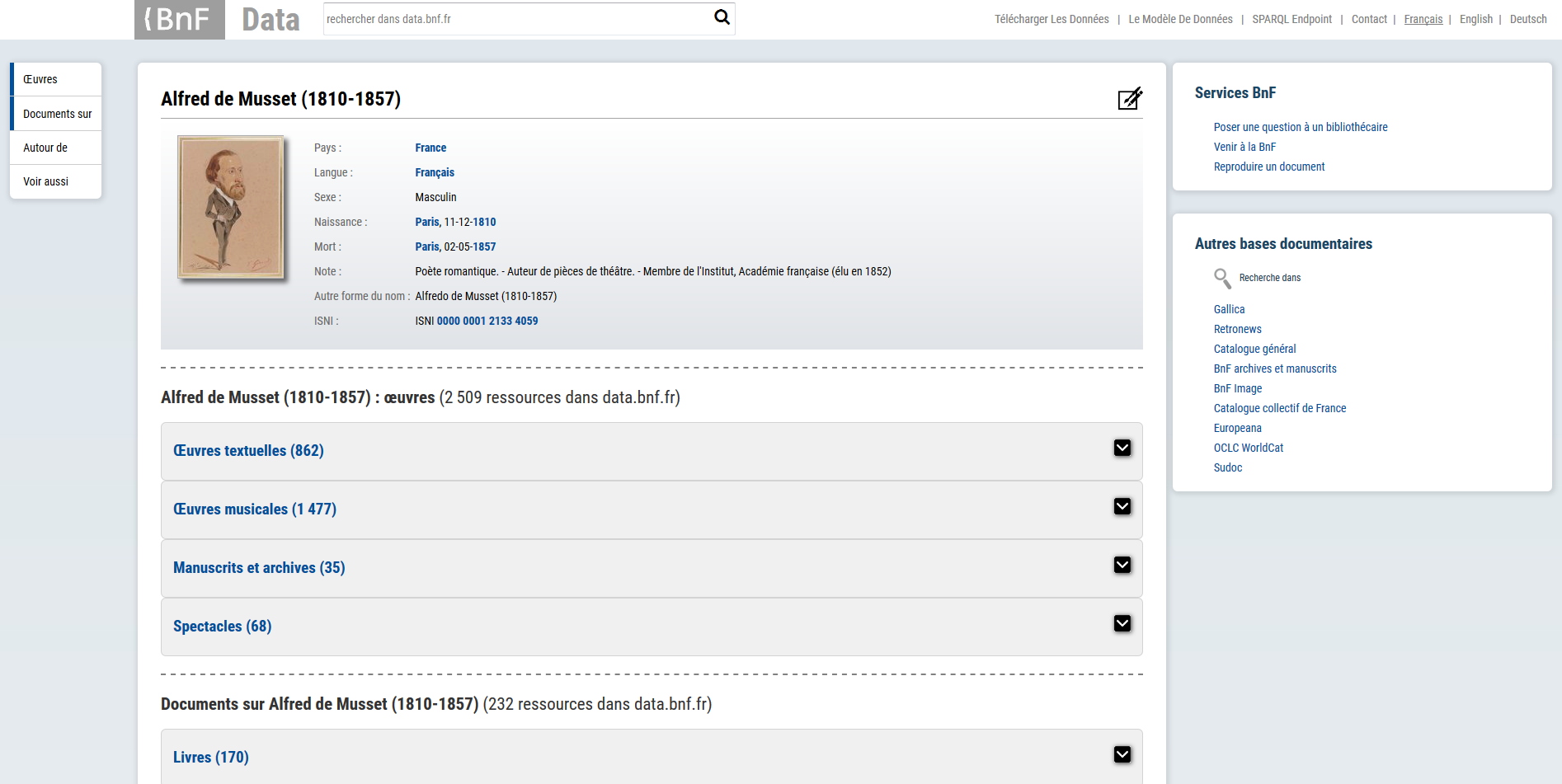
What you'll find... or not in data.bnf.fr
Data displayed in data.bnf.fr is extracted from BnF's catalogs and applications. All content found on the site is therefore related to the documents (prints, manuscripts, images, sound and audiovisual recordings, numismatic objects) curated by the BnF. More precisely, the pages of the site are built from authority records, which allow for the unambiguous identification of entities that may be referred to in several ways.
The material on these pages is consequently not exhaustive. In an author page, you will not necessarily find all of the most up-to-date biographical information.
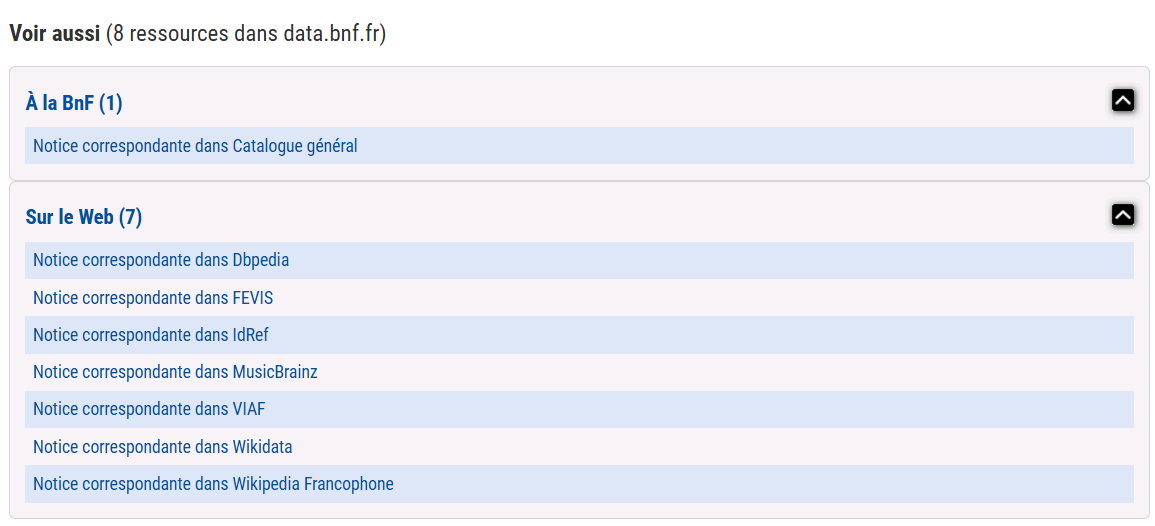
Nonetheless, data.bnf.fr links some of these data to external databases (section See also), to benefit from the resources of the linked open data. These links are also computed, so their number may fluctuate depending on the data displayed.
Data displayed in data.bnf.fr is updated periodically; it cannot be edited, with a few exceptions.
You are interested in a person or organization ?
In data.bnf.fr, individuals who have assumed intellectual responsibility (artists, translators, preface writers, etc.) for one or more documents cataloged at BnF are considered "authors." Organizations (commercial publisher, producer, etc.) are presented in the same way.
It is possible to browse the full list of these agents (authors, organizations, and even families). Using the search engine, creators are marked in the autocomplete with a blue label, and organizations with an orange label.
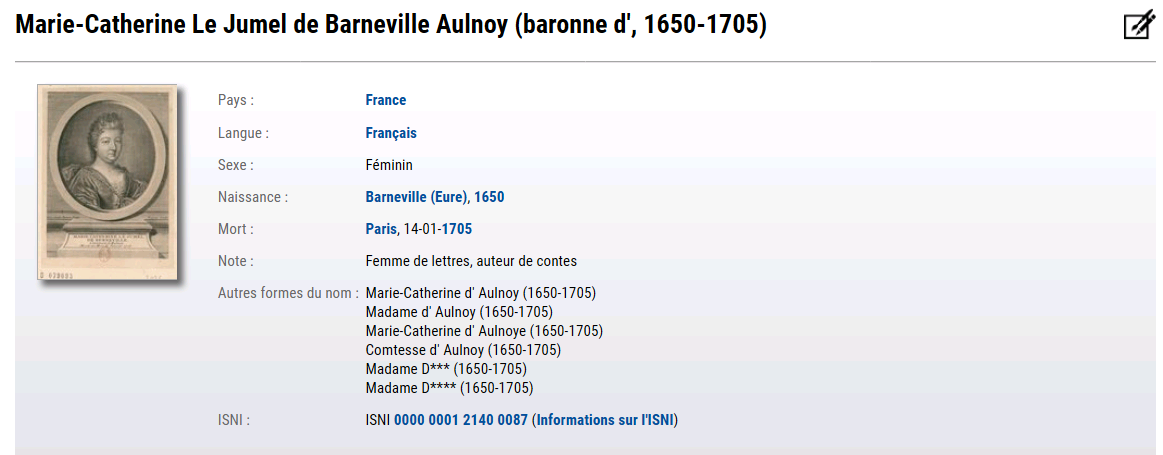
A box first provides an overview of the author's (or organization's) primary information as recorded at the time the document was cataloged. Therefore, having this information (professional status, organization addresses, websites) out of date is not properly an error.
In the body of the page, the information is grouped into six main sections: his works ( the clickable ones have a work page), adaptations based on his works, documents that have the author (or organization) as topic, a "related topics" section that collects topics that are jointly subject of the same work, a "related authors" section that lists people who have exercised joint responsibility for the same work, and finally a "See also" section that links to external databases.
Within the sections, there are filters and sort options that allow you to refine the list of resources displayed.
Please notice that once the sort and/or filter is applied, you should then click on the "See more documents of this kind" link to display all the resources corresponding to the selected criterion.
You're interested in a work?
You can browse the list of works available in data.bnf.fr, with the ability (as with authors' pages) to use facets, but as there are more than a million, you may find it easier to use the search engine.
Type in the title of the work you're looking for (or its first few words: autocomplete will suggest more), then click on the work (indicated by a green label), or, if there are too many results, hitting enter will take you to a more readable results page.
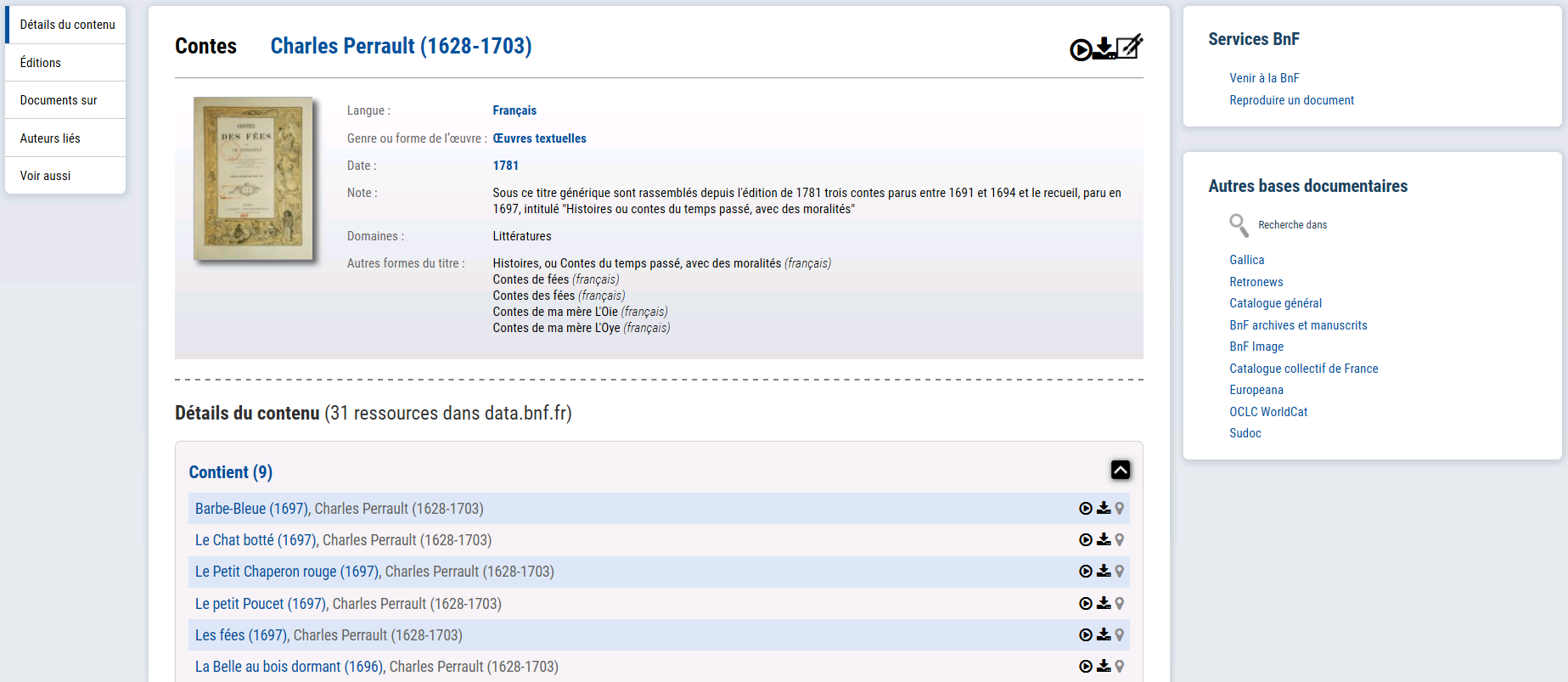
Once on a work page, you can navigate, from the left side menu, through several lists of documents: its various editions preserved at BnF, the other documents that have the same work as their topic, the people (classified by type of contribution) who contributed to an edition or a performance/reproduction of this work.
Within the sections of this page, depending on the typology of the documents covered, you can sort them (chronologically, alphabetically, or by choosing to privilege digitized documents) or apply filters to refine the results.
In some cases, a pictogram at the end of the line invites you to consult and/or download the digital version of the document archived in Gallica.
what does this red box mean?
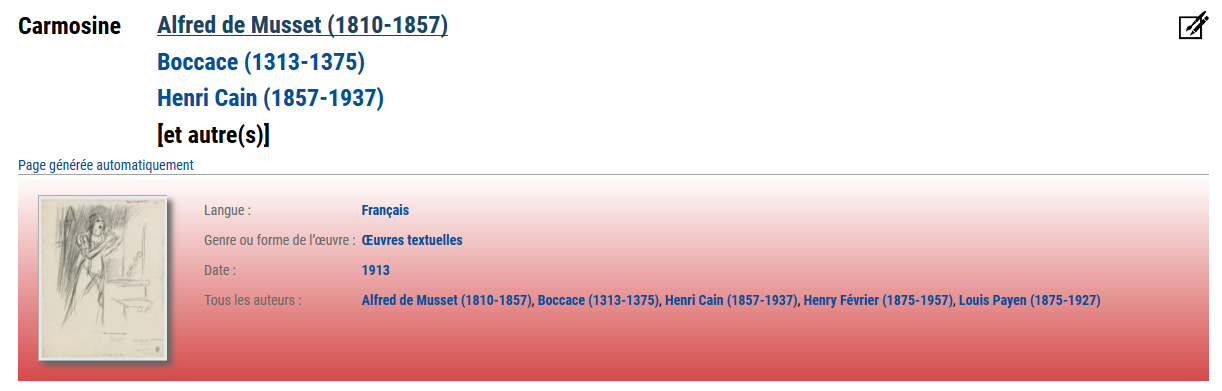
Data from the BnF's general catalog are not always suitable for generating a work page. Thus a set of algorithms has been developed to automatically construct these pages, when they did not exist. To warn visitors that their reliability is lower than others, they are presented in this way.
You're interested in a topic?
Topic pages allow you to browse the structure of subject headings used at BnF, from the most generic to the most specific. These pages use the vocabulary Rameau, and furthermore allow one to go back to the more generic "domains" of the Dewey classification.
In the body of the topic pages, you will find the documents that are related to this topic, as well as the creators whose works are also related to this topic.
You're interested in a serial publication (newspaper, magazine, journal)?
Serial pages briefly feature newspapers, magazines, newsletters. When newspapers are distributed in multiple local editions, they are listed in the "Related Periodicals" section, along with supplements and editions in other media (online edition, for example).
You're interested in a place?
Place's pdescription pages are built from two kinds of authority records: geographic names, which identify a place per se (place of publication, place of creation of an organization, etc.), and place records specific to the Rameau vocabulary. Each of these records is the source of a separate place page, but also of a place page merging the information from each of them. These are identifiable by their URL, which includes two numeric sequences between /en/ and the page label:
https://data.bnf.fr/en/11975583/15203569/paris__arrondissement__18___france_/, or by having 2 permalinks at the bottom.
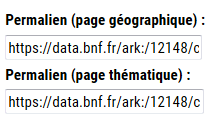
On a place page, you will find documents about that place (the "Documents about" section) and documents or authors related to that place (the "Related to" section). On these pages, a map provides a precise location of the place and displays other related places.
Are you interested in a time period?
Unlike other pages, those focused on a date or time period (for example, the 13th century) are not generated from an authority record. They only display relationships between works, organizations, authors, documents, etc. and that particular date.
You're interested in a performance?
Performance pages provide information about a stage creation. The box displays details about the show poster: main contributors (director, composer, etc.), and cast.
Within the page, sections refer to the related authors ( mostly the author of the play) and to the performance record in the BnF general catalog, which is the source of the information displayed on the page.
You're interested in a coin, a medal, an object?
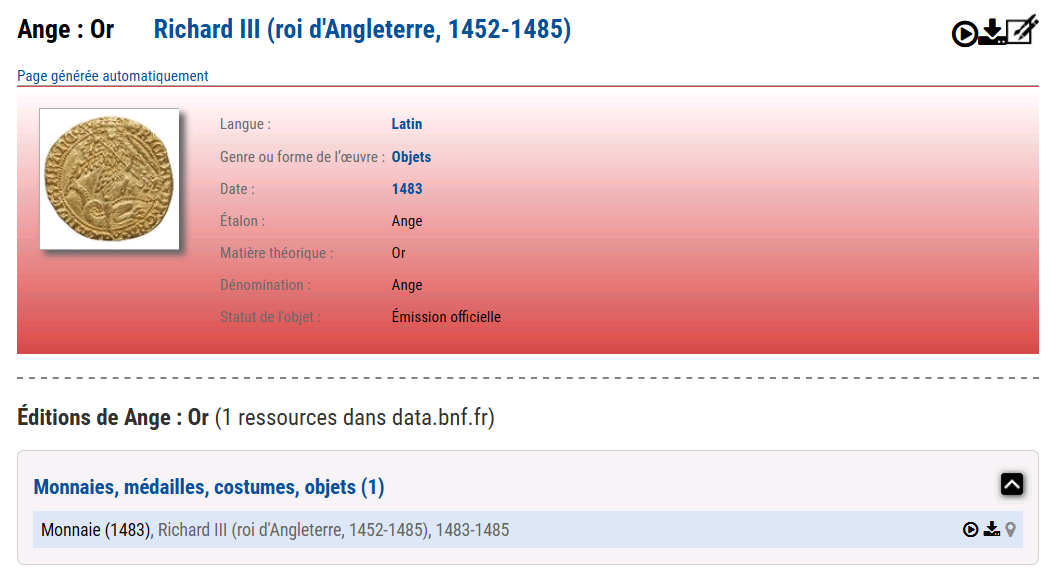
In data.bnf.fr, coins and medals are considered as works. The pages devoted to them are consequently built on the model of works pages.
The currency-issuing authority is thus presented as an author. The different coins kept at the BnF are, themselves, considered as editions of the same work.